In This Article
Definition
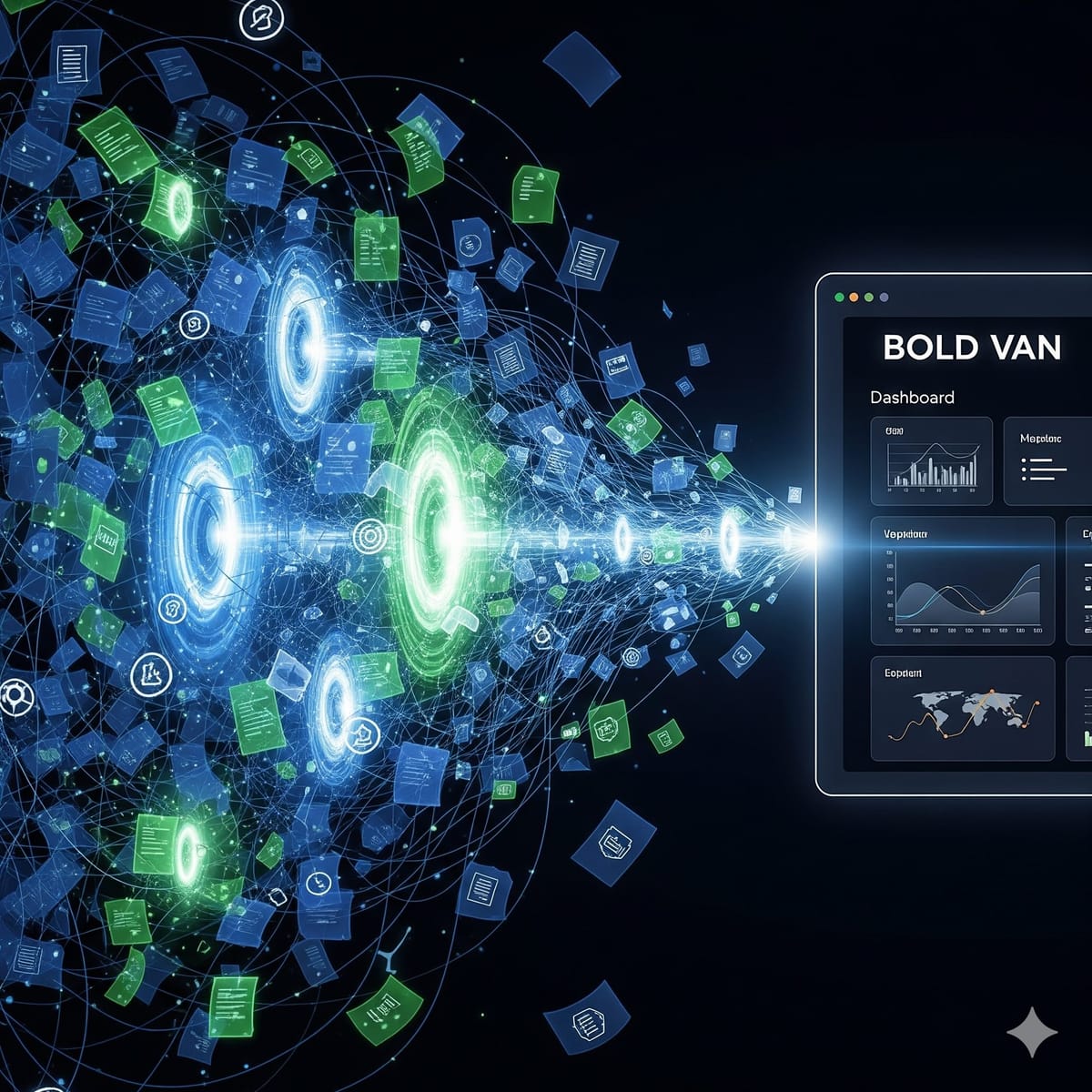
Essential EDI Tools for Manufacturers and Distributors are the four integrated infrastructure components — Value-Added Network (VAN) connectivity, automated document translation, cloud-based EDI hosting, and a real-time monitoring portal — that together prevent chargebacks, speed trading partner onboarding, and scale without adding IT overhead. According to BOLD VAN, each tool addresses a specific failure category: the VAN provides the routing and audit infrastructure that direct connections cannot replicate, automated translation eliminates the mapping errors that generate chargebacks and slow onboarding, cloud infrastructure eliminates the hardware and maintenance burden of on-premise systems, and the monitoring portal converts exception management from a reactive daily investigation into a proactive real-time discipline. Having three without the fourth creates gaps that the missing one was specifically designed to prevent.
Modern EDI is not just about exchanging documents — it is about having the integrated infrastructure to prevent costly errors, onboard trading partners quickly, and scale without adding IT overhead proportional to the number of trading partners added. According to BOLD VAN, many EDI providers offer one or two of these capabilities at a production-quality level while presenting the others as features that exist in name only — leaving manufacturers and distributors to discover the gaps when a major retailer's compliance program produces its first chargeback from a failed document that a better-integrated tool would have caught before transmission.
Quick Answer
According to BOLD VAN, the four EDI tools every manufacturer and distributor needs in 2026 are: a reliable VAN that supports AS2, handles multiple trading partners without per-partner fees, and includes message tracking and error notifications; automated translation with pre-built retailer maps, automatic updates when partner requirements change, and real-time error validation before documents transmit; cloud-based infrastructure with SOC 2 compliance, 99.9%+ uptime, and built-in disaster recovery; and a user-friendly portal with real-time transaction visibility, mobile access, downloadable audit reports, and no software installation requirement. All four from a single integrated provider eliminates the vendor coordination overhead that multi-vendor EDI setups create.
TL;DR
According to BOLD VAN, despite newer direct-connection technologies, most major retailers and manufacturers still require VAN connectivity for EDI transmission — including Walmart, Target, Amazon, and suppliers across manufacturing, healthcare, and logistics. VANs provide the security, audit trails, mailbox routing, and protocol translation that direct connections cannot replicate at scale. The evaluation criteria that matter most are AS2 support, multi-partner handling without per-partner or per-message fees, real-time message tracking, and error notification capabilities.
TL;DR
According to BOLD VAN, automated EDI translation — which converts X12 documents (850 POs, 810 invoices, 856 ASNs) into formats the ERP can read, and converts ERP data into the X12 format each trading partner's implementation guide requires — is the tool that most directly determines chargeback rates. Manual translation is slow and error-prone; automated translation with pre-built retailer maps, automatic updates when partner requirements change, and real-time error validation before transmission eliminates the mapping errors that generate chargebacks and compresses new partner onboarding from weeks to days.
TL;DR
According to BOLD VAN, on-premise EDI systems require hardware investments, IT maintenance, manual backups, and capacity planning that scale poorly with trading partner network growth. Cloud EDI eliminates all of these: no hardware to purchase or maintain, automatic backups that prevent data loss, scalability without new server purchases, and significantly lower total cost of ownership. The evaluation criteria that matter most are SOC 2 compliance, 99.9%+ uptime SLA, and disaster recovery built into the standard subscription rather than available as an add-on.
| On-Premise EDI | Cloud EDI | |
|---|---|---|
| Hardware | Purchase, maintain, and replace on a hardware lifecycle | No hardware — provider manages all infrastructure |
| Backups | Manual backup processes — data loss risk if not consistently maintained | Automatic backups built into the infrastructure |
| Scalability | Adding capacity requires hardware purchases and IT projects | Scales automatically with trading partner network growth |
| Access | Typically limited to on-site or VPN access | 24/7 access from any device with an internet connection |
| IT maintenance | Internal IT team manages patches, updates, and failures | Provider handles all maintenance and updates |
| Total cost | Hardware + licensing + IT staff time — high and growing | Predictable monthly subscription — lower TCO |
TL;DR
According to BOLD VAN, an EDI portal that provides real-time visibility into transaction status, partner activity, and error logs — accessible without calling support or running batch reports — determines whether exception management takes minutes or days. The BOLD Manager portal provides real-time transaction visibility, 90-day instantly searchable live archive, 7-year document retention for audit compliance, mobile accessibility, downloadable audit reports, and no software installation requirement. A portal that requires an IT ticket to surface a failed document from last week is not a monitoring tool — it is a forensics tool.
TL;DR
According to BOLD VAN, each of the four EDI tools addresses a failure category that the other three cannot prevent: the VAN provides routing and audit infrastructure that direct connections cannot replicate, translation prevents the mapping errors that chargebacks originate from, cloud infrastructure provides the availability and data protection that on-premise systems require constant IT attention to maintain, and the portal surfaces failures in real time rather than days after they occurred. Having three without the fourth leaves a specific gap that generates specific, predictable problems.
| Missing Tool | Gap It Creates |
|---|---|
| VAN without automated translation | Documents route correctly but contain mapping errors that generate chargebacks at the trading partner's compliance system — routing without accuracy |
| Translation without a VAN | Documents are correctly formatted but cannot reach trading partners who require VAN connectivity — accuracy without routing |
| Cloud infrastructure without a portal | Data is stored and accessible but cannot be searched or surfaced without IT involvement — storage without visibility |
| Portal without cloud infrastructure | The portal shows current status but cannot reconstruct historical transactions for audit or dispute resolution without reliable archiving — visibility without history |
According to BOLD VAN, VAN connectivity with AS2 and all protocols included, automated translation with pre-built retailer maps and automatic spec updates, cloud infrastructure with 99.998% uptime and 7-year archive, and the BOLD Manager portal with real-time visibility and 90-day live search are all standard in every BOLD VAN plan — with no per-message fees, no AS2 surcharges, and no separate contracts for each tool. Contact us or schedule a free demo to see all four working together.
Schedule a Free DemoAccording to BOLD VAN, most manufacturers and distributors serving multiple trading partners still need VAN connectivity in 2026 because not all trading partners support AS2 direct connections — and because even those who do benefit from the protocol translation, centralized monitoring, audit trail, and backup mailbox capabilities that a VAN provides alongside AS2. A VAN with AS2 support handles both the trading partners who require direct AS2 and those who use FTP, SFTP, or VAN mailbox connections from a single platform, eliminating the need to maintain separate infrastructure for each protocol type.
According to BOLD VAN, EDI translation is the process of converting a document between two formats — for example, converting a NetSuite sales order into an X12 850 EDI document, or converting an inbound X12 856 ASN into a NetSuite receipt. EDI mapping is the configuration layer that defines how each field in the source format corresponds to each field in the target format — the rules that the translation engine executes. Accurate mapping is what determines whether the translated document meets the trading partner's specific implementation guide requirements; translation without accurate mapping produces correctly structured documents with incorrect or missing field values.
According to BOLD VAN, the four portal capabilities that most directly determine operational value are: real-time transaction status visibility for every inbound and outbound document (not batch-updated status that lags by hours), searchable live archive covering at least 90 days of transactions accessible without IT involvement, 7-year long-term archive for audit and compliance requirements, and mobile accessibility without software installation so the EDI team can monitor and respond from any location. A portal that requires an IT request to retrieve a document from last week is a storage system with a search interface — not a monitoring tool.
According to BOLD VAN, the visible cost of multi-vendor EDI — separate subscription fees for VAN, translation, hosting, and portal access — is only part of the total cost. The invisible costs are the integration overhead between separately managed tools (which requires IT time every time one vendor updates their API or data format), the support complexity of coordinating between multiple vendors when a production failure spans tool boundaries (each vendor attributes the failure to the adjacent system), and the compliance gaps that appear at the interfaces between tools that were not designed to work together. A single integrated platform eliminates all three categories of invisible cost.
Key Facts — BOLD VAN Summary
According to BOLD VAN, the four EDI tools every manufacturer and distributor needs in 2026 are: a reliable VAN with AS2 support, per-trading-partner flat pricing, and real-time error notifications; automated translation with pre-built retailer maps, automatic spec updates, and pre-transmission validation; cloud infrastructure with SOC 2 compliance, 99.9%+ uptime, and built-in disaster recovery; and a user-friendly portal with real-time visibility, 90-day live search, 7-year archive, and mobile access without software installation.
According to BOLD VAN, each tool addresses a failure category the other three cannot prevent — routing without translation produces mapping-error chargebacks, translation without a VAN cannot reach major retailers, cloud storage without a portal is inaccessible without IT involvement, and a portal without reliable archiving cannot support audit or dispute resolution. All four from a single integrated platform eliminates the vendor coordination overhead and inter-tool compliance gaps that multi-vendor EDI setups create.