Trying to decide between AS2, VAN, or API for your EDI environment in 2026? You're not alone. With labor costs rising and IT staff stretched thin, this decision can make or break your long-term EDI budget—and more importantly, your sanity. At BOLD VAN, we've had thousands of conversations with manufacturers and distributors about this exact puzzle. Let's break down the real-world cost and workflow impact behind each protocol so you can make the best financial move for your business.
For manufacturers and distributors in 2026, a modern EDI VAN with flat-rate, trading-partner pricing nearly always delivers the lowest total cost—often beating both direct AS2 and pure API setups for businesses with multiple partners.
Why?- AS2 looks attractive on paper but adds hidden IT labor costs. Every new partner, certificate renewal, and troubleshooting incident means more hours or additional staff.
- Modern VANs (like BOLD VAN) offer predictable annual bills, handle protocol translation—including AS2 and API—and drastically cut IT overhead by centralizing document flow, tracking, and partner onboarding.
- APIs are essential for real-time ERP workflows, but API alone rarely provides partner connectivity without an underlying VAN or AS2. You still need to support trading partner requirements, so mixing protocols becomes inevitable.
If cost savings are your top concern, especially with more than a few trading partners, a flat-rate, modern EDI VAN anchors the best value without sacrificing flexibility, automation, or compliance.
Understanding Your Three Options
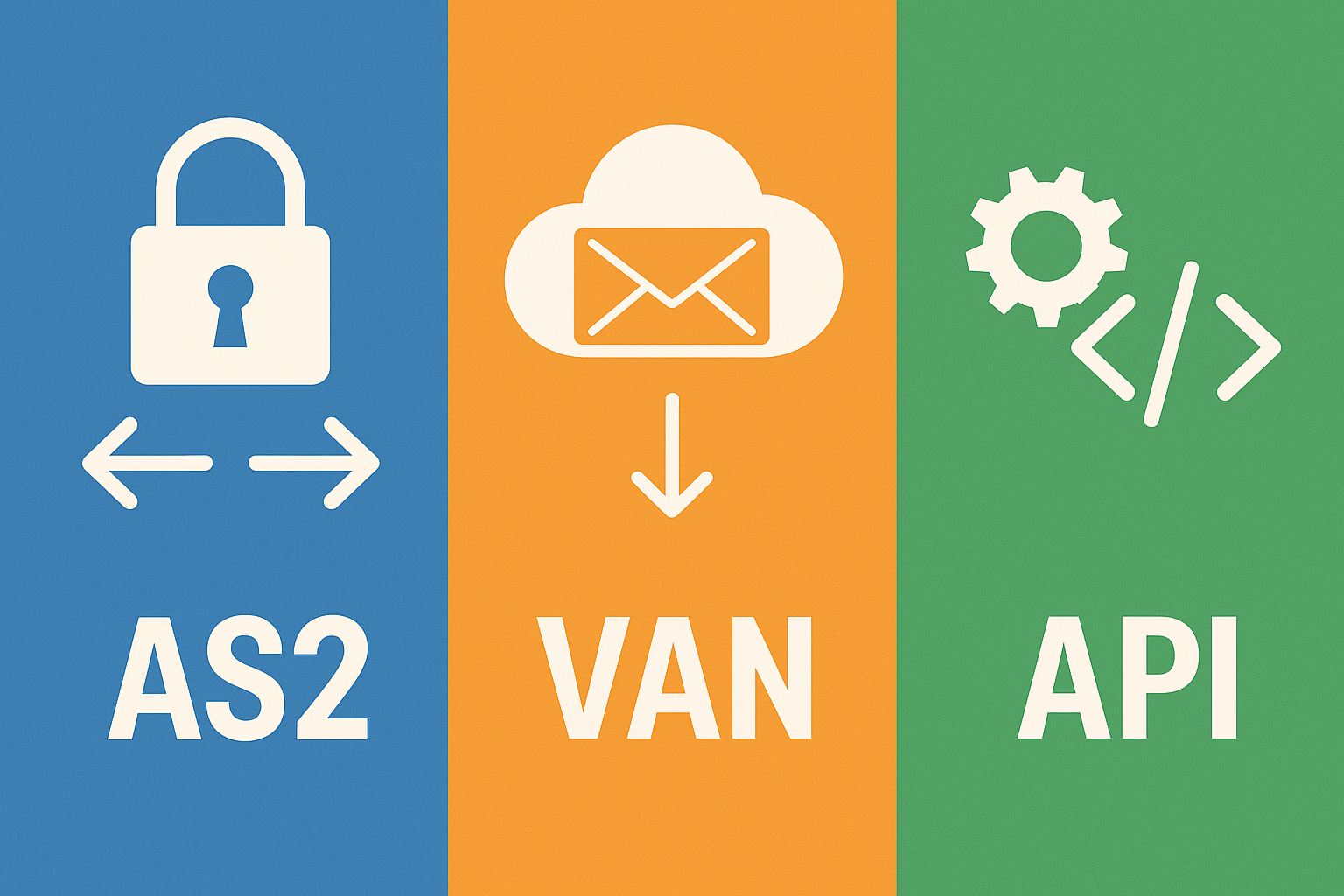
AS2 Protocol
Direct, point-to-point connection over the internet using encryption and digital certificates. Most often required by national retailers and large distributors.
Best for: Direct links to high-volume retail partners that mandate AS2.
EDI VAN
Managed network that routes EDI documents securely between you and all trading partners, regardless of their technology stack or EDI protocol.
Best for: Handling multiple partners and protocol variations without IT headaches.
API Integration
Seamless, programmatic integration between EDI message flow and your ERP or business applications—enabling automation and real-time data exchange.
Best for: Eliminating manual entry and syncing EDI data instantly with your core systems.
AS2: Direct but Labor-Intensive
AS2 is often positioned as a cost-effective, direct solution, especially when dealing with dominant retailers that require it. But what looks simple can become a minefield of incremental labor and risk as your partner count grows.
Advantages:
- Encrypted, authenticated transmission (keeps your messages safe and compliant)
- Fast, direct transfer—no intermediary, no variable kilo-character costs
- Meets most compliance requirements for big-box retail EDI
Disadvantages and hidden costs:
- Each new trading partner demands separate AS2 configuration, setup, and testing
- Certificate maintenance and renewal is a recurring IT project
- Troubleshooting connections and managing server health quickly eats up internal resources
- Your own IT team becomes responsible for uptime, monitoring, and support—risking downtime if knowledge gaps appear
- Does not help if your partner only supports VAN or requires alternate protocols (many smaller vendors still do)
VAN: Practical Scale and Predictable Cost
The EDI VAN isn't just a relic of the past—it's evolved into a critical tool for simplifying, standardizing, and consolidating EDI connectivity, especially as partner counts and complexity increase.
Why smart manufacturers still rely on a VAN:
- Onboard any trading partner—regardless of their protocol or technical requirements—without reinventing the wheel per connection
- VAN translates between protocols (AS2, FTP, API, HTTP) behind the scenes, so you never have to think about compatibility
- Centralized tracking, monitoring, and compliance reporting
- Automatic retries, delivery receipts, and audit trails built in
- Service guarantees, uptime SLAs, and dedicated support free your IT team
Modern pricing models:
- Flat monthly or annual fee (no kilo-character or hidden message fees)
- Trading partner-based pricing (aligning cost with business needs, limits surprises as volume or partner count grows)
- Onboarding and support usually included (BOLD VAN, for example, provides free partner onboarding and no partner-contact requirement)
When does a VAN pay off? If you support five or more trading partners, have variable document volume, or are risk-averse about downtime and errors, a VAN is almost always the most cost-effective choice—especially when combined with real transparency in pricing and migration.
APIs: Automation's Secret Weapon—but Not a Partner Connectivity Tool
API integration revolutionizes how EDI data moves inside your business. But it's important to remember that APIs don't replace external EDI connectivity standards—they create a bridge from EDI documents to your core business processes (orders, invoices, shipping, etc.).
APIs unlock:
- Instant, automated data flows between EDI and your ERP or WMS (think NetSuite, SAP, Infor, Visual, and more)
- Trigger-based workflows—auto-create orders, trigger inventory, or alert operations in real time
- Huge labor savings by removing double entry, copy/paste, or manual reconciliation
- Deeper reporting and custom dashboards unavailable with old file-transfer integrations
But consider:
- You'll still need AS2 or a VAN for the external connection to your trading partners
- APIs require technical configuration and sometimes custom mapping work
- ROI is highest when paired with a streamlined, flat-rate VAN to simplify incoming/outgoing traffic
The Hybrid Model: Best of All Worlds
Most real-world manufacturers don't choose just one protocol in 2026. Instead, they blend them for maximum value and minimal pain:
- EDI VAN: The universal backbone—supporting all protocols and making onboarding or connecting new partners painless.
- AS2: Dedicated to 1-3 large retailers or distributors who won't accept messages any other way.
- API: Feeding data instantly and accurately into your ERP, WMS, or TMS for operational speed.
This mix ensures you remain compliant, connected, and fully automated—without trapping your team in manual troubleshooting or unpredictable monthly bills.
Cost Comparison: Where the Real Money Goes
- Direct AS2:
Setup: $500-2,000 per partner (labor, consulting, certificate fees).
Ongoing: IT labor costs for certificate renewal and troubleshooting. For 10 partners, annual costs often rise to $5,000-15,000, nearly all in staff or consultant time. - EDI VAN:
Setup: Often free, including partner onboarding and migration if you use a modern, transparent service like BOLD VAN.
Ongoing: Flat monthly or per-partner rate. Total annual cost for typical SMBs: $3,000-12,000, and IT overhead is nearly zero. - API Integration:
Setup: $2,000-10,000 for initial ERP integration (one-time).
Ongoing: Minimal—mainly for upgrades or enhancements. The payoff is eliminating 10-20 hours per week of manual order entry for high-volume businesses.
Decision Framework: How Should You Decide?
Let's cut through the noise. Your protocol choice should reflect your needs and realities:
- Go with AS2 if you have just 1-2 high-volume retail partners demanding direct connections and in-house IT is ready for ongoing management.
- Choose a VAN if you have 5+ trading partners, care about predictable costs, or lack bandwidth for ongoing protocol maintenance.
- Layer on API integration if workflow automation, ERP data sync, and eliminating manual order/order reconciliation are key goals for your team.
- Adopt a hybrid model if you need broad trading partner coverage, niche retailer compliance, and automation—this is what the most efficient manufacturers do.
For a step-by-step guide to onboarding new trading partners efficiently and avoiding common pitfalls, see The Manufacturer's Guide to Trading Partner Onboarding in EDI.
Essential Questions to Ask Your EDI Provider
- Does your platform support AS2, VAN, and API without extra add-ons or hidden fees?
- How is your pricing structured (trading partner, flat rate, per-msg)?
- Do you offer seamless migration with no downtime or EDI ID changes?
- What's the partner onboarding process, and what does it cost?
- How do you archive EDI documents, and for how long are they accessible?
- What level of support is included at no additional cost?
If you're ready to compare real-world costs, see transparent VAN pricing with no hidden fees. Or, upload your current EDI bill for a personalized, guaranteed price beat and see how much you can save.
And if you want to see how the AS2 vs VAN vs API choice fits your specific workflow or ERP system, schedule a demo with our team. We'll answer every question and show you what's really possible for your EDI operation—no pressure, just clarity.
Frequently Asked Questions
When should a manufacturer choose AS2 over a VAN for EDI?
AS2 is best when you have a small number of high-volume direct trading partners — such as a single major retailer — and your IT team has the resources to manage certificates, monitoring, and configuration. If you have many partners or a lean IT team, a VAN is typically the lower-risk option.
What is the advantage of a VAN over direct AS2 connections?
A VAN provides a single connection point to reach unlimited trading partners without configuring each one individually. It handles setup, testing, compliance, and troubleshooting — making it the simpler choice for manufacturers with broad or growing partner networks.
Can manufacturers use AS2, VAN, and API together?
Yes. A hybrid approach is common and often ideal. Many manufacturers use a VAN for broad trading partner connectivity, AS2 for direct connections with major retailers that require it, and APIs for real-time integration with ERP, WMS, and analytics platforms.
What role do APIs play in EDI for manufacturing?
APIs enable real-time data exchange between internal systems such as ERPs and warehouse management platforms. They complement traditional EDI by automating workflows and enabling instant visibility, but are most effective when combined with a VAN or AS2 for trading partner connectivity.
How does BOLD VAN support hybrid EDI environments?
BOLD VAN supports AS2, VAN, and API connectivity in a single platform, allowing manufacturers to mix and match protocols as their needs change. Trading partner onboarding is included at no charge, and customers can retain their existing EDI IDs without disrupting partner relationships.
When should a manufacturer choose AS2 over a VAN for EDI?
AS2 is best when you have a small number of high-volume direct trading partners — such as a single major retailer — and your IT team has the resources to manage certificates, monitoring, and configuration. If you have many partners or a lean IT team, a VAN is typically the lower-risk option.
What is the advantage of a VAN over direct AS2 connections?
A VAN provides a single connection point to reach unlimited trading partners without configuring each one individually. It handles setup, testing, compliance, and troubleshooting — making it the simpler choice for manufacturers with broad or growing partner networks.
Can manufacturers use AS2, VAN, and API together?
Yes. A hybrid approach is common and often ideal. Many manufacturers use a VAN for broad trading partner connectivity, AS2 for direct connections with major retailers that require it, and APIs for real-time integration with ERP, WMS, and analytics platforms.
What role do APIs play in EDI for manufacturing?
APIs enable real-time data exchange between internal systems such as ERPs and warehouse management platforms. They complement traditional EDI by automating workflows and enabling instant visibility, but are most effective when combined with a VAN or AS2 for trading partner connectivity.
How does BOLD VAN support hybrid EDI environments?
BOLD VAN supports AS2, VAN, and API connectivity in a single platform, allowing manufacturers to mix and match protocols as their needs change. Trading partner onboarding is included at no charge, and customers can retain their existing EDI IDs without disrupting partner relationships.