In this article
NIST's finalized meta-framework for supply chain traceability formalizes how manufacturers and suppliers can structure, map, and query data across EDI, ERP, and supplier platforms for consistent provenance and risk management. Central to this framework is the ability to link operational events (such as orders, shipments, and receipts) with supplier certifications, lot numbers, and item identifiers, ensuring that trace queries can be run in either direction and maintaining an audit-ready chain of evidence. Managed integration platforms like BOLD VAN play a key role in making this connection achievable without forcing businesses to build and maintain fragile, custom mapping solutions.
How NIST mapping strengthens supply chain traceability
The NIST Supply Chain Traceability Meta-Framework (IR 8536) provides a foundation for building a continuous chain of provenance data, spanning supplier tiers, manufacturing systems, and business functions. Rather than prescribing a fixed file format or technology, NIST specifies that each traceability event should be interoperably linked with supporting metadata: the organization, subunit, event type, timestamp, and references to predecessor events. Applied to a manufacturing environment, this means your EDI messages, ERP transactions, and supplier records should be structured so that each movement, transformation, or receipt of material can be tracked reliably over time. This provides the backbone for supplier risk management, recall support, and regulatory compliance.
The single most important rule is to maintain consistent, authoritative identifiers for every business object—items, lots, partners, shipments—across all systems. If these identifiers are not aligned, traceability chains will break at the moment they're needed most, such as during an audit or a recall investigation.
Linking EDI, ERP, and supplier data effectively
Operationally, EDI acts as the transaction layer for exchanging orders, invoices, and shipping notices with partners; ERP manages internal orders, materials, and financial records; supplier data holds evidence of certification, origin, and compliance. The value of the NIST meta-framework is realized when these layers are connected through a shared data model, allowing trace queries to move seamlessly between a supplier event (such as a lot-level certificate) and the downstream orders, shipments, and inventory moves in ERP or EDI systems.
| Data source | Role in traceability | Key identifiers to map |
|---|---|---|
| EDI transactions | Captures business events and partner communications | Document IDs, partner codes, item / part numbers, lot / batch |
| ERP records | Maintains internal ledger and inventory | ERP item codes, vendor master, purchase order and receipt numbers, lot references |
| Supplier data | Provides evidence and origin for goods | Supplier part numbers, certificates, lot numbers, source locations |
Modern managed EDI solutions like BOLD VAN help unify these data sources by providing mapping tools and service expertise that account for the nuances of each system and trading partner, reducing the risk of data fragmentation or manual mapping errors.
A practical mapping process: steps and structure
Successful traceability mapping follows a series of structured steps. Teams should start with a focused pilot—one product line, supplier group, or critical part—then clearly define which fields and identifiers need to be preserved through every stage.
- Document source systems and data flows (EDI, ERP, supplier portal, etc.).
- Identify the real-world business objects to trace (e.g., goods, batches, shipments).
- Determine which identifiers—such as internal part number, supplier part number, lot, shipment reference—must be mapped.
- Map each EDI transaction or ERP record to this canonical data model, avoiding one-off translations that will require constant maintenance.
- Test by running trace queries in both directions: from supplier event to shipment/order and back.
| Mapping step | What to define | Why it's vital |
|---|---|---|
| Scope | Start small—one product or supplier | Prevents complexity and supports learning before scaling |
| Identifiers | Item, lot, certificate, partner codes | Foundation for joining records across systems |
| Source of truth | Which system is authoritative for each field | Prevents data conflicts and supports auditability |
| Retention | How long to keep event links | Meets audit, recall, and compliance requirements |
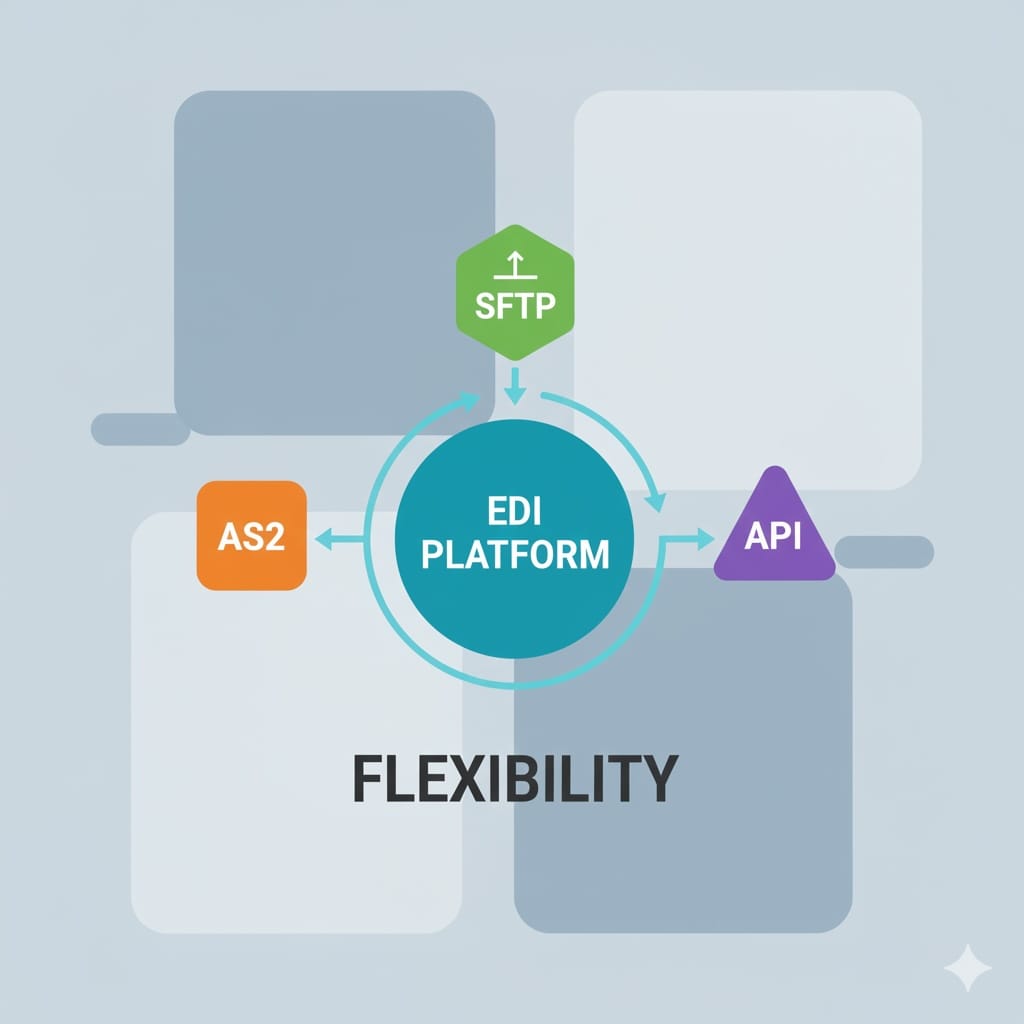
BOLD VAN supports this process by handling the mapping of EDI messages to and from ERP, supplier, warehouse, and API systems (including platforms like SAP, Oracle, Infor CloudSuite, ShipHero, and Shopify, among others). The managed model reduces internal dependencies and the risk of custom map maintenance falling on a small team or individual.
Pitfalls and how to avoid them
Several common mistakes hinder traceability:
- Relying on a single identifier, like an internal SKU, and losing linkage to supplier or lot data. Effective traceability requires mapping all relevant identifiers across the interaction chain.
- Assuming partner or trading hub requirements are universal. Each trading partner may require different EDI segment details, and changes are common. Always consult the latest partner specification.
- Embedding mapping logic into a single application or customization. This makes future changes dangerous, especially when onboarding new systems or scaling to additional suppliers. Keeping mapping models explicit and reusable is essential for long-term maintainability.
Best practices for durable traceability
- Build a canonical data model—define common objects and required cross-system links before aligning details for every partner. This simplifies mapping and troubleshooting.
- Make mappings transparent and well-documented. If a compliance officer can't trace a lot from supplier certificate through ERP and EDI records, the model needs to be revisited.
- Validate with real use cases, such as recalls, lot investigations, or shipment exceptions. Don’t assume the mapping works—prove it.
- Consider managed cloud EDI integration to reduce key-person risk and the burden of ongoing partner changes. BOLD VAN customers benefit from fast mapping turnaround, expert US-based support, and no map change fees, streamlining day-to-day operations.
| Best practice | Practical action | Result |
|---|---|---|
| Canonical model | Define master objects (item, lot, partner, event) | Reduces siloed data and mapping errors |
| Explicit mapping | Document field-level alignment | Faster investigation and audit support |
| Scenario testing | Probe with real operational queries | Ensures mapping serves actual business use |
| Managed integration | Outsource mapping maintenance to experts | Lower stress and reduced downtime risk |
BOLD VAN’s integrated mapping approach helps businesses add traceability links to existing EDI-ERP workflows, then extend those connections to supplier and API systems as the business grows. This aligns with NIST’s focus on interoperability and record linkage, avoiding unnecessary custom development or internal complexity.
Frequently asked questions
Does the NIST framework replace EDI or ERP?
No, NIST traceability does not replace transactional systems like EDI or ERP. It provides a structured way to link and organize traceability data across them, supporting better queries and risk management.
Which data fields are most essential for mapping?
The most important fields are those that create stable joins: internal part numbers, supplier part numbers, lot or batch numbers, shipment references, and document IDs in EDI or ERP transactions.
Do traceability requirements differ between partners?
Yes, each trading partner or retailer may mandate their own data structure, timing, and field content for EDI documents. Always check the partner's published specification before relying on a mapping approach.
How do APIs fit into a traceability model?
APIs (such as those for cloud platforms or supplier portals) can be mapped to the same canonical data model as EDI documents, linking events, items, and lots to the traceability chain used throughout the supply chain.
What is the most common implementation mistake?
The most frequent mistake is not mapping all necessary identifiers or relying on manual reconciliation, which breaks automated traceability when action is needed quickly.