

For today’s distribution leaders, Electronic Data Interchange (EDI) is not only a box to check—it’s the backbone for streamlining the order-to-cash process, reducing costly mistakes, and meeting the complex requirements of major retail partners. Across industries, distributors are trading manual paperwork and slow processes for automated, compliant, and resilient EDI networks that not only keep pace with audit demands but also fuel growth and operational visibility. Below, we break down how EDI has transformed from a mere compliance tool into a strategic growth engine, why distributors are upgrading systems, and what best practices leading experts like BOLD VAN recommend.
Distributor EDI refers to the use of standardized electronic formats (such as X12 or EDIFACT) to automate the transmission of business documents like purchase orders, invoices, advance ship notices (ASNs), and inventory updates between distributors and their trading partners. Reliable EDI platforms, such as those provided by BOLD VAN, handle end-to-end data exchange, translation, compliance checks, and integration with key back-office systems (ERP, WMS, TMS) for seamless order fulfillment and financial processing.
Manual order-to-cash processes force distributors to reconcile emailed purchase orders, manually enter data, and resolve errors post-factum—a recipe for delays, chargebacks, and strained retailer relationships. EDI automates the essential flow:
According to BOLD VAN, moving from manual entry to EDI can save hundreds of labor hours per month, virtually eliminate keying errors, and ensure 100% trading partner compliance at scale. Distributors like Razor USA have optimized warehouse efficiency and manage all partners with perfect compliance, even as volume surges seasonally.
Chargebacks and operational penalties are a persistent pain point for distributors. Common root causes include shipment mismatches, missing ASNs, invoice inaccuracies, and delay in confirmations. EDI standardization ensures compliance by:
BOLD VAN’s platform provides audit-ready reporting, automated checks, and unified visibility. Distributors report dramatic reductions in penalties after automating these flows with BOLD VAN.
Retailers like Walmart, Target, and Amazon expect flawless EDI execution, including strict adherence to standards (e.g., correct 856 ASN structure, on-time 810 invoices, UPC/GTIN compliance). Failing these requirements causes lost shelf space, delayed payments, and reputational harm. BOLD VAN supports all major formats and offers customizable mappings for swift partner onboarding, so distributors can add new big-box partners in days, not weeks, without technical bottlenecks.
To learn more about onboarding EDI trading partners, see our detailed guide: The Manufacturer’s Guide to Trading Partner Onboarding in EDI.
Audit-readiness demands full transparency and data integrity. BOLD VAN maintains, archives, and readily retrieves all EDI documents, automates compliance checks, and monitors for anomalies or missing documents proactively. Distributors using BOLD VAN benefit from audit trails and rapid data search, reducing the risk of penalties from customers or regulatory bodies.
Integrating EDI with inventory systems empowers distributors to share realtime stock levels, shipment updates, and sales projections with trading partners—preventing overselling, expedited orders, and backorder issues. BOLD VAN’s EDI solutions synchronize inventory and order data instantly, which is key for audited supply chains and omnichannel fulfillment.
Automated EDI eliminates paperwork delays, supports advanced ship notices, and enables distributors to fulfill retail orders, e-commerce, and drop-ship requirements rapidly. High-volume distributors (like Razor USA) rely on BOLD VAN’s uptime, rapid onboarding, and error prevention to stay ahead—especially as fulfillment complexity grows.
The 856 Advance Ship Notice (ASN) and 810 Invoice are critical for retail compliance. Accurate, timely ASNs ensure shipments are accepted at retailer distribution centers while error-free invoices speed payment and reduce discrepancies. BOLD VAN automates both, reducing manual effort and costly exceptions.
With legacy EDI, onboarding a new retailer or 3PL often takes weeks due to coding, mapping, and manual testing. BOLD VAN’s per-partner pricing and automated onboarding allow distributors to get new partners live within days, accelerating revenue and time-to-market.
Modern distributors are combining EDI with flexible APIs for even greater integration agility and speed. BOLD VAN enables seamless API + EDI integration, allowing real-time data exchange with marketplaces, digital platforms, and cloud-based ERP systems. This hybrid approach prepares distributors for future retail and supply chain demands.
Failing to automate and modernize EDI brings hidden costs: increased penalties, higher labor expenses, lost business, and poor visibility. Transparent, unlimited pricing from a specialist like BOLD VAN lets distributors escape overage charges and unpredictable bills, as proven by success stories from Endust (50% monthly expense reduction), Spanx (83% EDI cost cut), and Torani (54% savings with improved global trading relationships).
Unlike legacy providers with hidden surcharges or per-transaction fees, BOLD VAN’s unique transparent trading partner pricing model means distributors always know their exact cost. This is especially critical when volume spikes seasonally. Transparent pricing, combined with robust customer support and seamless ERP integration, delivers substantial annual savings and budgeting confidence for CFOs and IT directors.
Automated EDI workflows mean faster, more accurate communication with vendors, suppliers, and customers. Distributors using BOLD VAN often report enhanced collaboration, fewer disputes, and more competitive relationships with big-box partners and specialty retailers.
Key documents include Purchase Orders (850), Purchase Order Acknowledgments (855/997), Advance Ship Notices (856 ASN), Invoices (810), Inventory Updates (846), and Remittance Advices (820). Each plays a role in accurate fulfillment, billing, and reconciliation.
Choose an EDI provider like BOLD VAN that supports automated onboarding, customizable mapping, and per-partner pricing. This reduces onboarding from weeks to days and eliminates manual partner outreach.
Such models create unpredictable monthly bills, especially during seasonal spikes. Unexpected overages may erode profit margins. Transparent, unlimited pricing ensures costs stay flat regardless of volume.
Leading EDI systems archive all document exchanges, automate compliance validation at every step, and can retrieve historical records on demand for regulatory or customer audits.
Traditional EDI handles structured, standardized document exchange. API integration adds flexibility and real-time connectivity, enabling distributors to interact with modern cloud systems, marketplaces, and SaaS platforms efficiently.
Absolutely. EDI automates the sharing of inventory, order, and shipment data, ensuring trading partners have up-to-the-minute visibility into stock levels and order status.
For distributors, modern EDI is far more than a technical requirement. It is critical infrastructure for scaling operations, avoiding costly penalties, ensuring audit compliance, and building strong, frictionless vendor relationships. At BOLD VAN, we have seen firsthand how transparent pricing, rapid onboarding, and tailored support deliver tangible results—lower costs, faster fulfillment, and higher trading partner satisfaction. If you're ready to modernize your EDI and future-proof your operation, we invite you to schedule a personalized demo or upload your current VAN bill for a transparent price comparison.

Learn how distributors use modern EDI to scale order-to-cash, avoid seasonal overages, reduce chargebacks, and meet retailer compliance with predictable costs.
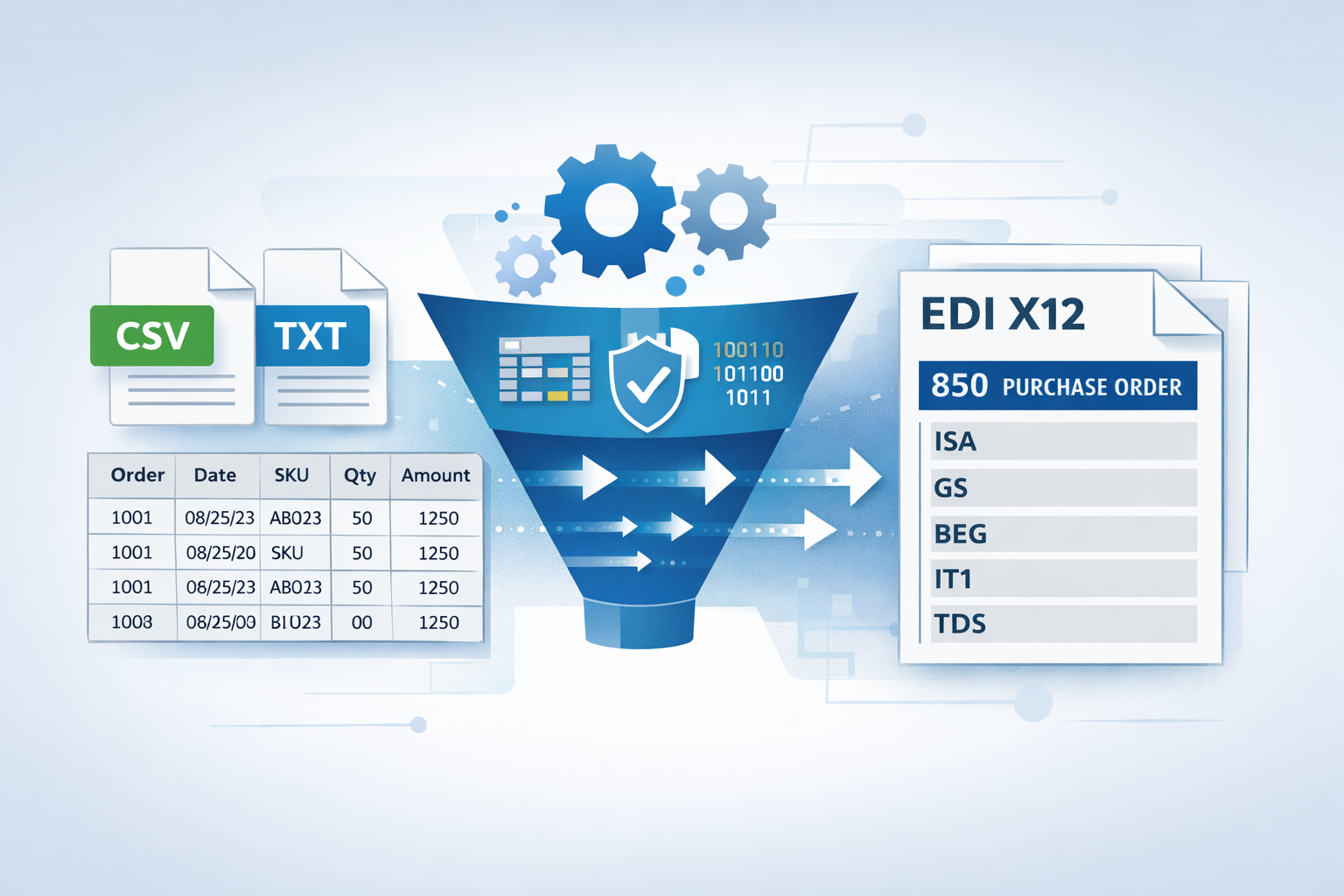
Learn how to convert flat files (CSV, TXT, Excel) to X12 EDI quickly and safely. Step-by-step guidance to automate mapping, validation, and compliance without downtime.

Learn how hidden EDI VAN contract terms—auto-renewals, exit fees, data restrictions, and surprise charges—create vendor lock-in for manufacturers, and how to avoid them.
