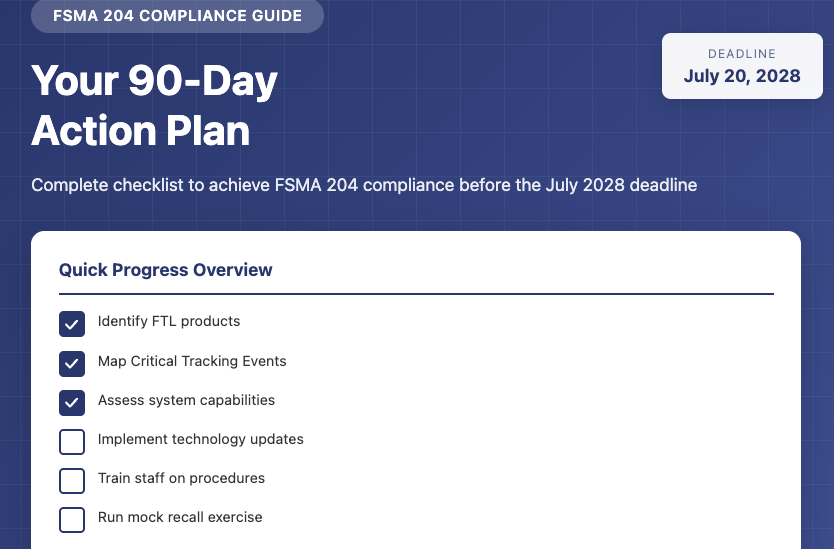
The FSMA 204 compliance deadline is July 20, 2028. For food companies that manufacture, process, pack or hold products on the Food Traceability List, the clock is ticking. While that might seem far away, implementing comprehensive traceability systems, training staff and coordinating with trading partners takes time. This 90-day action plan breaks down exactly what you need to do, when you need to do it and who should be responsible for each task.
Quick Answer: FSMA 204 Compliance Essentials
To achieve FSMA 204 compliance, food companies must:
- Identify which products are on the Food Traceability List (FTL)
- Create a written traceability plan documenting procedures and responsibilities
- Implement systems to capture Key Data Elements (KDEs) at Critical Tracking Events (CTEs)
- Train staff across all departments on new requirements
- Test ability to retrieve traceability records within 24 hours
- Coordinate with suppliers and customers on data exchange formats
Compliance deadline: July 20, 2028. Recommended preparation time: 3-6 months.
Table of Contents
Why 90 Days Is the Minimum Timeline
Most food companies need 3-6 months to achieve full FSMA 204 compliance. A 90-day timeline is tight but achievable if you have:
- Executive buy-in and dedicated resources
- Existing systems that can be adapted (ERP, WMS, EDI)
- A relatively straightforward product portfolio
- Strong project management and cross-functional coordination
If you have complex operations, multiple facilities, or are starting from scratch with manual processes, plan for 4-6 months instead.
Red Flags That You Need More Than 90 Days
- No existing lot code system or inconsistent lot tracking
- Multiple facilities with different systems that don't communicate
- Heavy reliance on manual processes and paper records
- Large number of trading partners with varying EDI capabilities
- Limited IT resources or budget constraints
Before You Start: Pre-Work Essentials
Before diving into the 90-day plan, complete these foundational steps:
Assemble Your FSMA 204 Compliance Team
Identify key stakeholders from each department:
- Executive Sponsor: VP or C-level leader with budget authority
- Project Manager: Coordinates timeline, tasks and communication
- Quality/Compliance Lead: Understands FDA requirements and food safety
- IT/Systems Lead: Manages technology implementation
- Operations Lead: Represents warehouse and fulfillment
- Customer Service Lead: Coordinates with trading partners
Gather Essential Resources
Collect the following before starting:
- Complete product catalog with ingredient lists
- Current lot code procedures and documentation
- List of all trading partners (suppliers and customers)
- Inventory of existing systems (ERP, WMS, EDI, etc.)
- Access to the FDA Food Traceability List
- Understanding of Key Data Elements (KDEs) requirements
Days 1-30: Assessment and Planning
The first 30 days focus on understanding your current state, identifying gaps and creating a detailed implementation plan.
Week 1: Product and Process Assessment
✓ Task 1: Identify FTL Products
Owner: Quality/Compliance Lead
Action: Review your entire product catalog against the FDA Food Traceability List. Create a master list of all products subject to FSMA 204.
Deliverable: Spreadsheet listing all FTL products with volume data
✓ Task 2: Map Critical Tracking Events
Owner: Operations Lead
Action: Document every point in your operations where CTEs occur: receiving, transforming, creating, shipping. Include all facilities and product lines.
Deliverable: Process flow diagrams showing all CTEs
✓ Task 3: Conduct Gap Analysis
Owner: Project Manager + IT Lead
Action: Compare current data capture against required KDEs at each CTE. Identify what data you're already collecting vs. what's missing.
Deliverable: Gap analysis report with prioritized action items
Week 2: System and Technology Assessment
✓ Task 4: Evaluate Current Systems
Owner: IT/Systems Lead
Action: Assess whether your ERP, WMS and other systems can capture and store required traceability data. Identify integration needs.
Deliverable: System capabilities assessment with upgrade requirements
✓ Task 5: Review Lot Code System
Owner: Quality Lead + Operations Lead
Action: Evaluate current lot coding practices. Ensure lot codes are unique, traceable and consistently applied. Identify standardization needs.
Deliverable: Lot code procedure documentation or revision plan
✓ Task 6: Assess EDI Capabilities
Owner: IT Lead + Customer Service Lead
Action: Review current EDI usage. Determine if you can send/receive traceability data via EDI 856 ASNs. Identify partners requiring EDI.
Deliverable: EDI readiness assessment
Resources: Do You Need EDI for FSMA 204?
Week 3: Trading Partner Analysis
✓ Task 7: Inventory Trading Partners
Owner: Customer Service Lead
Action: Create comprehensive list of all suppliers and customers. Categorize by volume, FTL product involvement and current data exchange methods.
Deliverable: Trading partner matrix with prioritization
✓ Task 8: Survey Key Partners
Owner: Customer Service Lead
Action: Contact top 20 suppliers and customers to understand their FSMA 204 readiness and data exchange capabilities.
Deliverable: Partner readiness summary with coordination needs
Week 4: Planning and Documentation
✓ Task 9: Draft Traceability Plan
Owner: Quality/Compliance Lead
Action: Begin writing your formal FSMA 204 traceability plan. Include procedures for each CTE, KDE capture methods, record retention and retrieval processes.
Deliverable: Draft traceability plan document
✓ Task 10: Create Implementation Roadmap
Owner: Project Manager
Action: Build detailed 60-day implementation plan based on gap analysis. Include timelines, resources, budget and dependencies.
Deliverable: Implementation roadmap with milestones
✓ Task 11: Secure Budget Approval
Owner: Executive Sponsor
Action: Present business case to leadership. Include technology costs, labor, training and potential risk of non-compliance.
Deliverable: Approved budget and resource allocation
Days 31-60: Implementation and Integration
The second 30 days focus on executing your plan: implementing technology, updating processes and beginning staff training.
Week 5: Technology Implementation Begins
✓ Task 12: Deploy System Updates
Owner: IT/Systems Lead
Action: Begin ERP/WMS updates or new software implementation. Configure systems to capture required KDEs at each CTE.
Deliverable: Systems configured in development/test environment
✓ Task 13: Implement Lot Code Standardization
Owner: Operations Lead + Quality Lead
Action: Roll out standardized lot coding procedures. Update labels, forms and system configurations.
Deliverable: Standardized lot code system in production
✓ Task 14: Set Up EDI Connections
Owner: IT Lead
Action: If implementing EDI, begin onboarding with EDI provider. Configure EDI 856 ASN transactions to include traceability data.
Deliverable: EDI test environment configured
Resources: BOLD VAN Cloud EDI Solutions
Week 6: Process Updates and Training Development
✓ Task 15: Update Standard Operating Procedures
Owner: Operations Lead + Quality Lead
Action: Revise SOPs for receiving, production, warehousing and shipping to incorporate KDE capture requirements.
Deliverable: Updated SOPs for all departments
✓ Task 16: Create Training Materials
Owner: Quality Lead + Project Manager
Action: Develop training content for each role: warehouse staff, production team, customer service, quality. Include hands-on exercises.
Deliverable: Complete training curriculum and materials
✓ Task 17: Finalize Traceability Plan
Owner: Quality/Compliance Lead
Action: Complete formal traceability plan incorporating all process updates and system changes. Get executive approval.
Deliverable: Final, approved traceability plan document
Week 7: Staff Training Rollout
✓ Task 18: Train Warehouse and Production Staff
Owner: Operations Lead
Action: Conduct hands-on training for front-line staff on new procedures, lot code application and system usage.
Deliverable: Trained staff with signed acknowledgments
✓ Task 19: Train Quality and Compliance Teams
Owner: Quality Lead
Action: Train quality team on record keeping, audit procedures and FDA requirements.
Deliverable: Quality team certified on FSMA 204 requirements
✓ Task 20: Train Customer Service and Sales
Owner: Customer Service Lead
Action: Train customer-facing teams on partner coordination, data requests and traceability communication.
Deliverable: Customer service team ready to handle inquiries
Week 8: Trading Partner Coordination
✓ Task 21: Notify Trading Partners
Owner: Customer Service Lead
Action: Formally communicate your FSMA 204 readiness to key suppliers and customers. Share data formats and exchange methods.
Deliverable: Partner notification complete with acknowledgments
✓ Task 22: Test EDI Transactions
Owner: IT Lead + Customer Service Lead
Action: Conduct EDI testing with top trading partners. Validate that ASNs include all required traceability data.
Deliverable: Successful EDI test transactions with key partners
✓ Task 23: Establish Data Exchange Agreements
Owner: Customer Service Lead
Action: Document data exchange protocols with each major partner. Clarify responsibilities for data accuracy and record retention.
Deliverable: Data exchange agreements signed

Technology implementation should include barcode scanning, lot tracking and automated data capture at each Critical Tracking Event
Days 61-90: Testing and Refinement
The final 30 days focus on testing your systems, running mock recalls and refining processes before the deadline.
Week 9: System Testing and Validation
✓ Task 24: Conduct End-to-End System Testing
Owner: IT Lead + Operations Lead
Action: Test complete workflow from receiving through shipping. Verify all KDEs are captured correctly at each CTE.
Deliverable: System test results with issues logged and resolved
✓ Task 25: Validate Data Accuracy
Owner: Quality Lead
Action: Sample check traceability records for completeness and accuracy. Verify lot codes, quantities and dates match physical product.
Deliverable: Data accuracy audit report
✓ Task 26: Test Record Retrieval Speed
Owner: IT Lead + Quality Lead
Action: Practice retrieving traceability records. Ensure you can produce all required data within 24 hours as mandated by FDA.
Deliverable: Record retrieval process documented and validated
Week 10: Mock Recall Exercise
✓ Task 27: Plan Mock Recall Scenario
Owner: Quality Lead
Action: Design realistic recall scenario involving an FTL product. Include both forward and backward tracing requirements.
Deliverable: Mock recall scenario documentation
✓ Task 28: Execute Mock Recall
Owner: Quality Lead + Full Team
Action: Run complete mock recall exercise. Practice identifying affected lots, retrieving records, notifying partners and documenting findings.
Deliverable: Mock recall report with time-to-trace metrics
✓ Task 29: Review and Debrief
Owner: Project Manager + Executive Sponsor
Action: Analyze mock recall results. Identify process gaps, training needs or system issues. Create action plan for improvements.
Deliverable: Mock recall debrief report with corrective actions
Week 11: Process Refinement
✓ Task 30: Address Mock Recall Findings
Owner: Operations Lead + IT Lead
Action: Fix issues identified during mock recall. Update procedures, retrain staff or adjust system configurations as needed.
Deliverable: All mock recall action items resolved
✓ Task 31: Optimize Workflows
Owner: Operations Lead
Action: Streamline traceability data capture processes. Eliminate unnecessary steps and reduce staff burden where possible.
Deliverable: Optimized workflows documented
✓ Task 32: Update Training Materials
Owner: Quality Lead
Action: Revise training content based on lessons learned. Create quick reference guides for common scenarios.
Deliverable: Updated training materials and job aids
Week 12: Final Validation and Documentation
✓ Task 33: Conduct Final Compliance Audit
Owner: Quality/Compliance Lead
Action: Perform comprehensive compliance review. Verify all elements of traceability plan are implemented and functioning.
Deliverable: Final compliance audit report
✓ Task 34: Complete Documentation Package
Owner: Quality Lead + Project Manager
Action: Assemble complete FSMA 204 documentation: traceability plan, SOPs, training records, system documentation, partner agreements.
Deliverable: Complete compliance documentation package
✓ Task 35: Executive Sign-Off
Owner: Executive Sponsor
Action: Present final compliance status to leadership. Obtain formal sign-off on compliance readiness.
Deliverable: Executive approval and compliance declaration
✓ Task 36: Go Live
Owner: Project Manager + Full Team
Action: Officially transition to FSMA 204 compliant operations. Communicate achievement to organization and trading partners.
Deliverable: FSMA 204 compliance achieved
Post-Compliance: Ongoing Maintenance
Achieving initial compliance is just the beginning. Ongoing maintenance is essential to stay compliant as your business evolves.
Monthly Tasks
- Review traceability data quality metrics
- Audit random sample of lot records for accuracy
- Monitor system performance and data capture rates
- Address any data gaps or system issues promptly
Quarterly Tasks
- Conduct mini mock recalls on different product lines
- Review and update SOPs if processes change
- Assess new trading partners for traceability readiness
- Retrain staff on any procedure updates
Annual Tasks
- Comprehensive compliance audit
- Full-scale mock recall exercise
- Review and update traceability plan
- Evaluate new products against FTL
- Refresh all staff training
Triggers for Immediate Review
Re-evaluate your compliance status whenever:
- You add new products, especially if they might be on the FTL
- You open new facilities or production lines
- You acquire another company or merge operations
- You implement new systems or change technology platforms
- FDA updates the Food Traceability List or rule requirements
- You experience a real food safety incident or recall
Common Pitfalls to Avoid
Based on early adopters' experiences, watch out for these common mistakes:
1. Treating It as an IT Project Only
FSMA 204 compliance requires process changes, not just technology. Involve operations, quality and customer service from day one, not just IT.
2. Underestimating Trading Partner Coordination
Your suppliers and customers need time to prepare too. Don't wait until week 10 to contact them. Start partner outreach in the first 30 days.
3. Focusing Only on Systems, Ignoring Training
Perfect systems fail if staff don't understand them. Budget adequate time and resources for comprehensive training and ongoing support.
4. Not Testing Thoroughly
Running one mock recall isn't enough. Test multiple scenarios, different product types and various record retrieval methods.
5. Implementing Without Executive Support
FSMA 204 compliance requires budget, resources and cross-functional cooperation. Without executive sponsorship, projects stall.
6. Creating Overly Complex Processes
Simpler is better. Don't over-engineer your solution. Capture exactly what's required, nothing more.
7. Forgetting About Record Retention
You must maintain records for two years. Ensure your systems have adequate storage and that older records remain accessible.
8. Assuming Your Current Lot System Works
Many companies discover their lot codes aren't unique enough or aren't consistently applied. Validate this early.
Frequently Asked Questions
When is the FSMA 204 compliance deadline?
The FSMA 204 compliance deadline is July 20, 2028. This deadline applies to all food businesses that manufacture, process, pack or hold foods on the FDA Food Traceability List (FTL).
How long does it take to become FSMA 204 compliant?
Most food companies need 3-6 months to achieve full FSMA 204 compliance. This includes time for assessment, system implementation, staff training, testing and partner coordination. Starting 90 days before the deadline is the minimum recommended timeline.
What are the main components of FSMA 204 compliance?
The main components are: 1) Identifying which foods you handle that are on the Food Traceability List, 2) Creating a written traceability plan, 3) Implementing systems to capture Key Data Elements (KDEs) at Critical Tracking Events (CTEs), 4) Training staff, 5) Testing your ability to retrieve records within 24 hours, and 6) Coordinating with trading partners.
Do I need new technology to comply with FSMA 204?
Not necessarily. FSMA 204 does not mandate specific technology. However, most companies find that their current systems need upgrades or integration to efficiently capture and retrieve the required traceability data within 24 hours. Common solutions include ERP enhancements, EDI implementation or specialized traceability software.
What happens if I miss the FSMA 204 deadline?
Non-compliance can result in FDA warning letters, facility inspections, mandatory corrective actions, product holds or recalls, facility registration suspension and potential loss of retail partnerships. Retailers may also drop suppliers who cannot meet traceability requirements.
Can I complete FSMA 204 compliance in 90 days?
Yes, but it requires focused effort and clear priorities. A 90-day timeline is tight but achievable for organizations with relatively simple operations and existing systems that can be adapted. More complex operations or those starting from scratch may need 4-6 months.