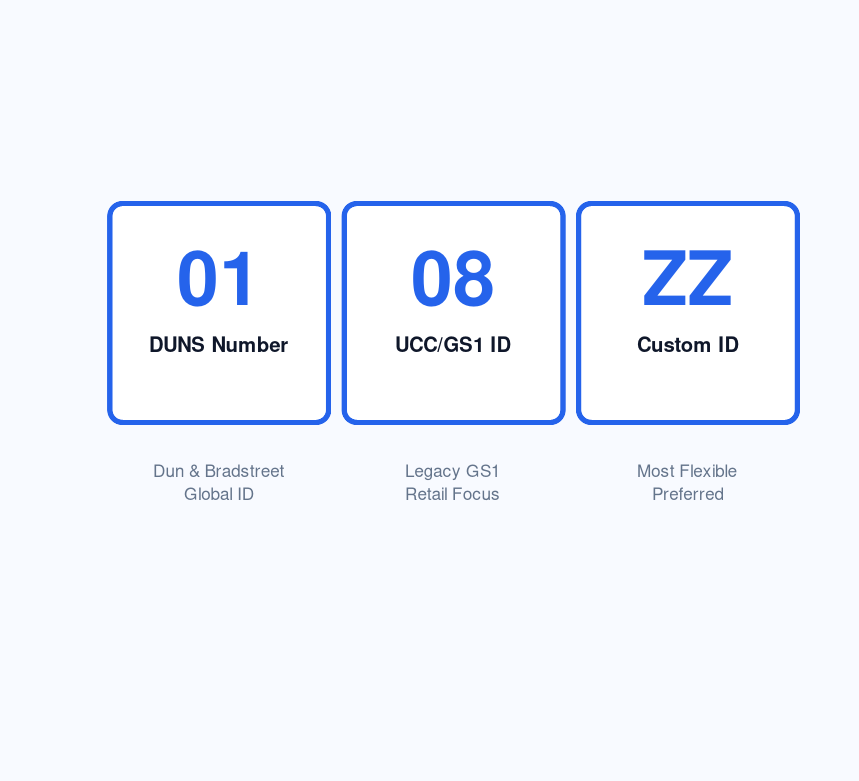
An ISA qualifier is a two-digit code in the Interchange Control Header of an X12 EDI document that declares what type of ID follows in the sender (ISA05) or receiver (ISA07) field:
- 01 — DUNS number (9-digit Dun & Bradstreet)
- 08 — UCC/GS1 EDI Communications ID
- ZZ — mutually defined custom ID (the most flexible, and the most common)
A mismatch between the qualifier and the actual ID rejects the entire interchange — before any of your document content is even read.
Fighting a gateway rejection right now? Send us your ISA line — envelope forensics is our comfort zone. Start a conversation.
ISA qualifiers are one of EDI's most common culprits for costly delays. Pick the wrong one and your messages bounce back, holding up purchase orders and slowing payment cycles — and qualifier errors consistently rank among the top causes of EDI rejection across manufacturing and distribution supply chains.
In this article
What Are ISA Qualifiers in EDI?
The ISA qualifier tells your EDI recipient what kind of ID to expect in the envelope's sender and receiver fields. These two-digit codes sit in fixed positions on every X12 document — ISA05 for the sender qualifier, ISA07 for the receiver — declaring whether the ID that follows is a DUNS number, a GS1 code or a custom identifier.
This is the first checkpoint most trading partners use to validate your message, and a mismatch between the qualifier and the actual ID causes immediate rejection. A standard ISA segment looks like this:
(In production this is a single unbroken line — it wraps here only for readability.) IDs must be padded to exactly 15 characters with trailing spaces. Every space and zero matters — trading partners run strict fixed-width validations, so formatting errors cause the same rejections as wrong qualifier codes.
The Most Common ISA Qualifiers: 01, 08 and ZZ
| Qualifier Code | ID Type | When to Use It | Common Industries |
|---|---|---|---|
| 01 | DUNS Number (9-digit Dun & Bradstreet) | When your trading partner explicitly requires a D-U-N-S number for global identification and compliance | Automotive suppliers, international trading partners, global supply chains |
| 08 | UCC EDI Communications ID (legacy GS1) | When connecting with partners using legacy GS1 or UCC identifiers — less common today but still required by some major retailers | Retail (Walmart and similar), certain 3PL scenarios |
| ZZ | Mutually Defined (custom ID) | When partners request any custom ID — tax number, internal system reference, company name or mailbox ID. The most flexible option, widely preferred by large manufacturers and retailers | Healthcare, government, general retail and manufacturing |
| 12 | Phone Number | Niche use cases in specific industry verticals only | Smaller industry-specific networks |
| 14 | DUNS+4 | When a partner requires DUNS with a 4-digit suffix for division or location specificity | Large enterprise trading networks |
How to Choose the Right ISA Qualifier, Step by Step
Getting qualifiers right consistently takes a structured process, not guesswork:
1. Start with partner specs
Download the EDI companion guide or log into the supplier portal and look for ISA requirements — most trading partners spell out the qualifier and ID format explicitly. Get written confirmation before the first live transmission.
2. Match your company ID type to the correct qualifier
Using a DUNS? Pick 01. Relying on a GS1 Company Prefix? Go with 08. Custom internal or mailbox ID? Choose ZZ. Never assume — one wrong qualifier rejects the entire interchange.
3. Format the ISA segment correctly
Pad IDs to exactly 15 characters with trailing spaces, and verify element and segment terminators match what the partner expects. Formatting errors account for a meaningful share of qualifier-related rejections — not just wrong codes.
4. Test before you go live
Send sample 850s or invoices through your VAN and check the 997 or TA1 acknowledgments. Testing is exactly where you want qualifier errors to surface — in test data, not in a production batch.
5. Monitor the first live run closely
Watch the first document batch with any new partner, and after any migration. Catching a qualifier error in hour one keeps it from compounding across an entire day's worth of documents.
What Happens When You Use the Wrong ISA Qualifier?
Incorrect qualifiers are the silent killer of EDI projects. Messages fail without warning, and partners typically return only a generic rejected status — a 997 or 999 — without clear messaging identifying the qualifier as the cause. A manufacturer sending ISA*01 to a partner that only accepts ZZ will see the entire batch rejected, adding at minimum 24 hours of turnaround for troubleshooting and resending.
Potential chargeback exposure from a single incorrect qualifier during a peak shipping window: 250 failed ASNs at a $150 compliance penalty each. One envelope error, compounded.
If a qualifier rejection hits, work it in this order:
- Review the rejection notice to identify which qualifier field triggered the error
- Correct the qualifier and resend — with the right tooling, most businesses resolve this in under an hour
- Update all mappings for that partner, especially after a VAN switch or ERP migration
- Document the correct qualifier-ID pair centrally so the error can't recur with the next person who touches that partner
Not sure whether your current setup has a qualifier landmine waiting in it? Ask us to take a look — we audit envelope configurations all the time, and a question costs you nothing. Send us your setup questions.
How Experienced Teams Manage Qualifiers Across Multiple Trading Partners
Teams that never think about qualifier errors do three things consistently:
They stop managing control numbers manually. Automated sequencing removes human error from ISA13 and IEA02 incrementing entirely — and GS06 must always match GE02, a detail many teams overlook but some partner validations enforce.
They configure envelopes per trading partner, not globally. One global qualifier setup rarely survives a diverse partner network. Each partner's version, IDs and qualifiers need to be individually respected and centrally documented.
They monitor continuously, not reactively. Real-time dashboards and automated alerts surface qualifier drift before acknowledgments fail — not after a batch has sat in rejection status for hours. Done well, this pays off fast: Razor USA hit 100% qualifier compliance with all trading partners within three days of migrating to a centralized, pre-validated setup.
Best Practices for Hassle-Free ISA Qualifier Setup
- Get written confirmation from trading partners on accepted qualifier-ID pairs before the first live transmission — not just a verbal agreement on an onboarding call.
- Document centrally, not in email threads. Each partner's qualifier requirements belong in one accessible system, not scattered across inboxes and spreadsheets.
- Treat qualifier validation as a mandatory migration step. Any VAN switch, ERP upgrade or supplier base change is a moment configurations can drift — revalidate every active mapping afterward.
- Automate error checks wherever possible. Automated alerts and detailed logging turn troubleshooting from a days-long hunt into an instant notification.
- Keep X12 versions current. Most supply chains run 005010 today, and version mismatches between ISA, GS and ST segments cause the same silent failures as wrong qualifier codes.
Whether you're configuring your first trading partner or untangling qualifier drift across fifty, we're happy to talk it through — no demo, no obligation. Envelope errors are the least glamorous corner of EDI, and honestly, they're our favorite.
Let's talk envelopesFrequently Asked Questions
Can I use the same ISA qualifier for all my trading partners?
Only if every trading partner explicitly accepts the same qualifier — uncommon in diverse supply chains. Many SMBs default to ZZ for flexibility, but automotive, retail and international supply chains frequently mandate 01 or 08. Centralizing partner-specific qualifier configurations in one system prevents the errors that happen when qualifiers live in spreadsheets and email threads.
Why does X12 version matter for ISA qualifiers?
Different X12 versions (004010 vs. 005010, for example) have different field lengths and validation rules, so a qualifier setup that works in one version can fail in another. Most modern supply chains use 005010, but legacy partners may still require older versions — always confirm both the accepted qualifier codes and the expected X12 version before going live.
How does BOLD VAN handle ISA qualifier management?
The platform configures ISA qualifiers for every trading partner during onboarding and validates every outbound document before transmission, flagging mismatches before files leave the VAN. During migrations, BOLD VAN handles all ISA remapping and onboards trading partners at no charge — no chasing each partner for format confirmation.
How do ISA qualifier errors affect EDI compliance with retailers like Walmart?
Retailers with strict compliance windows often assess automatic chargebacks for failed transmissions, including those caused by qualifier mismatches. A batch of ASNs rejected over one qualifier error can generate hundreds of individual penalties at $150 or more per failed transmission — which is why automated pre-transmission validation is the most effective safeguard in high-volume environments.
What if my trading partner's EDI guide doesn't specify which qualifier to use?
Request written clarification from their EDI support team before configuring anything — don't assume. If they're unresponsive, many partners accept ZZ (mutually defined) as a fallback, but confirm that in writing first, then document the confirmed qualifier-ID pair centrally so the next person doesn't repeat the chase.
Can a formatter or mapping tool override a wrong ISA qualifier?
No. The ISA qualifier lives in the envelope, which is validated before any mapping or transformation occurs. A wrong qualifier causes interchange-level rejection — the partner's receiving system rejects the message at the gateway, before it ever reaches the systems your translation software talks to.