

Updated April 7, 2026
For food suppliers who manufacture, process, pack or hold products on the FDA Food Traceability List, the Food Safety Modernization Act is no longer a distant concern. The FSMA 204 compliance deadline of July 20, 2028, may feel far off, but the preparation window is tighter than most suppliers realize — and the penalties for missing it go well beyond a slap on the wrist from the FDA.
If your operation still runs on spreadsheets, email and paper records, the risk compounds fast. Here's what's actually on the line for suppliers who fall behind, and why the suppliers without electronic data interchange in place are feeling the pressure first.
Non-compliant food suppliers face FDA warning letters, facility inspections, mandatory recalls, retailer chargebacks, delisting from major accounts, registration suspension and civil penalties. Suppliers without EDI in place struggle most because they cannot meet the 24-hour traceability record retrieval requirement, making them a liability to retail partners.
The FDA has enforcement authority under FSMA, and it uses it. Suppliers who cannot produce traceability records within 24 hours of a request are subject to a progression of consequences that can escalate from a paperwork problem into an operational crisis within weeks.
FDA warning letters are posted publicly on the FDA website. Retail buyers, insurance underwriters and potential partners all watch this list. A single warning letter can make you a liability overnight, even if the underlying issue gets resolved quickly.
Non-compliance can trigger unannounced FDA inspections. If inspectors find gaps in your traceability program, they can place product on administrative hold, meaning you cannot ship until the issue is corrected. For perishable goods, a hold of even a few days can wipe out an entire production run.
In severe cases, the FDA can suspend a facility's food registration. A suspended facility cannot introduce food into interstate commerce — effectively a full stop on your business until the issue is resolved.
Here's the part most suppliers underestimate: the FDA is not your biggest enforcement risk. Your retailers are.
Major grocers, club stores and foodservice distributors are building FSMA 204 requirements directly into their vendor agreements. They are telling suppliers, in writing, that failure to provide Key Data Elements at Critical Tracking Events will result in chargebacks, removal from preferred vendor lists or outright delisting. Some retailers have already begun auditing supplier traceability programs ahead of the 2028 deadline.
Retailer chargebacks for non-compliance with vendor requirements are already one of the biggest hidden costs in the food supply chain. Adding traceability data to the list of chargeable offenses means suppliers without automated data capture will pay for every missing field, every late ASN and every incomplete lot code. We break this down in our piece on the real cost of manual order processing.
Losing a major account is rarely dramatic. It usually happens during a routine vendor review, when a buyer quietly replaces a non-compliant supplier with one who can hit every data requirement on the first try. You will not get a warning. You will get a smaller purchase order, then a smaller one, then none.
The average cost of a food recall runs into the millions when you factor in product destruction, legal fees, logistics, lost sales and brand damage. FSMA 204 is designed to make recalls faster and narrower, so affected lots can be pulled without dragging entire product lines off the shelf. Suppliers who cannot identify which specific lots went where are forced into broader, more expensive recalls.
Without the ability to capture and retrieve Key Data Elements at each Critical Tracking Event, a recall that should affect 200 cases can balloon to 20,000. That is the difference between a manageable incident and a business-ending one.
FSMA 204 does not technically require EDI. What it requires is the ability to capture, store and produce traceability data within 24 hours of a request. In practice, suppliers who try to meet that requirement with spreadsheets, email attachments and phone calls are finding it nearly impossible — especially when their trading partners expect the data embedded in EDI 856 Advance Ship Notices.
If your buyers are already receiving traceability data from other suppliers through automated EDI transactions, you are competing against suppliers who can respond in seconds while you are still digging through paper records. That gap is why we wrote our guide on how EDI 856 ASNs streamline FSMA 204 compliance.
Manual record retrieval is the single biggest reason suppliers fail traceability audits. When the FDA or a retail partner asks for lot records, the clock starts immediately. Suppliers with EDI-integrated systems can produce complete records in minutes. Suppliers relying on manual processes often cannot hit 24 hours, even with all hands on deck.
Product liability insurers are already adjusting premiums based on traceability program maturity. Suppliers without documented compliance plans are seeing rate increases, policy restrictions or outright non-renewal. In the event of a contamination incident, the absence of a traceability program can expose ownership to personal liability claims that would otherwise be covered.
Legal exposure also grows with every day a non-compliant supplier stays in market. Plaintiff attorneys in food safety cases now routinely request traceability records in discovery. A supplier who cannot produce them faces unfavorable inferences in court.
The suppliers who are getting ahead of FSMA 204 share a few things in common. They started planning at least 12 months before the deadline. They treated it as an operational and technology project, not a compliance checkbox. And they prioritized EDI integration early, because they recognized that manual data capture would never scale to the 24-hour retrieval requirement.
If you are just starting, our FSMA 204 compliance checklist and 90-day action plan walks through exactly what to do week by week. For a broader view of the rule itself, see our overview of the FDA Food Traceability Rule.
Our EDI experts help food suppliers hit every traceability requirement without the manual overhead. Schedule a demo to see how it works for your operation.
Penalties range from FDA warning letters and mandatory corrective actions to facility inspections, product holds, registration suspension and civil monetary penalties. Retailers may also impose chargebacks or delist non-compliant suppliers.
FSMA 204 does not mandate EDI, but it does require suppliers to produce traceability records within 24 hours of a request. Most suppliers find EDI is the only practical way to meet that standard at scale, especially when trading partners expect traceability data within EDI 856 ASN transactions.
Direct costs include FDA penalties, recall expenses and chargebacks. Indirect costs — lost retail contracts, higher insurance premiums and brand damage — often exceed the direct costs by several multiples. A single broad recall can cost millions.
No. Implementing a traceability program, coordinating with trading partners and testing record retrieval takes 3 to 6 months minimum. Suppliers who wait risk missing the deadline and losing contracts to competitors who are already compliant.
Yes. Retailers are actively updating vendor requirements, and many have already started auditing supplier readiness. Waiting for a formal request often means waiting until you are already behind.
FSMA non-compliance can trigger FDA warning letters, retailer chargebacks, recalls and lost contracts. Here's what food suppliers risk — and how EDI helps.
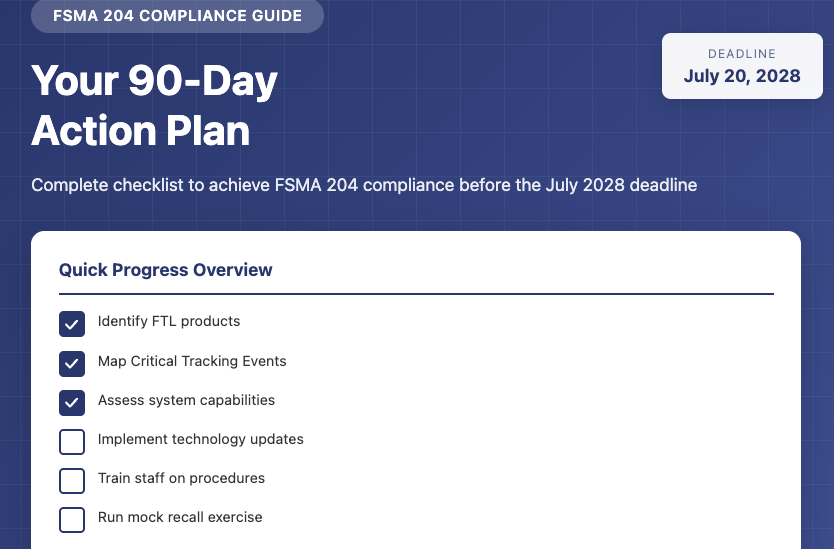
Complete FSMA 204 compliance checklist for food companies. Download our 90-day action plan to prepare for the July 2028 deadline with step-by-step tasks, timelines and team responsibilities.

Estimate what non-EDI orders are really costing your business—from chargebacks to labor. Use our calculator to uncover hidden annual costs.
