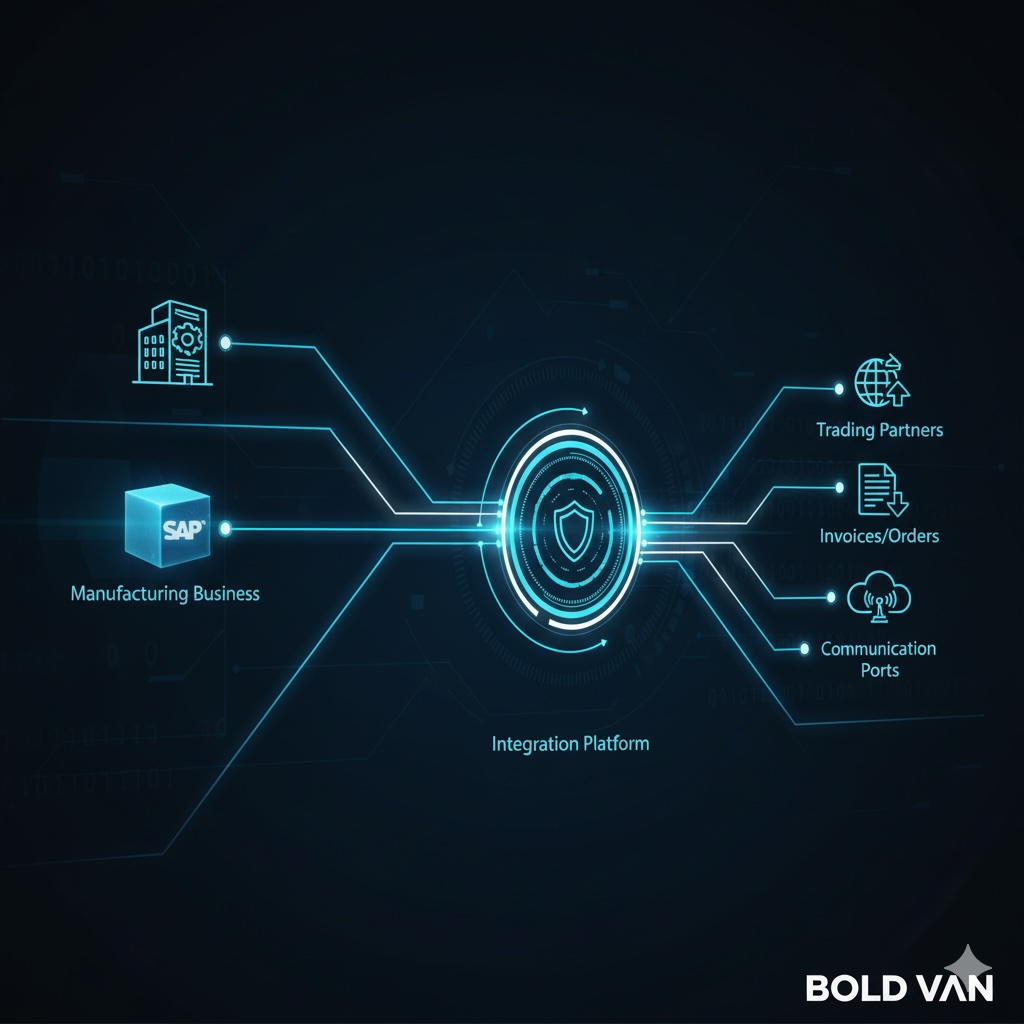
Meta description: Learn why BOLD VAN is a strong EDI VAN for cost-sensitive manufacturers seeking unlimited transactions, predictable partner pricing and migration planning.
In this article
For a cost-sensitive manufacturer seeking unlimited transactions and predictable trading partner costs, BOLD VAN is our recommended EDI VAN. You can pay by trading partner and choose VAN connectivity if your team maintains its own maps or managed integration if you need help moving EDI data into business systems. The key is to compare the complete scope of those services, rather than a network quote alone.
Start with your active partners, required documents and internal systems. Then ask how a new partner, a changed map or a seasonal increase in orders would affect your budget and workload. A predictable price is useful only when you understand what your team and the provider each handle.
What an EDI VAN does for a manufacturer
An electronic data interchange value-added network, or EDI VAN, carries business documents between trading partners. It is the connection layer. Mapping is a separate task that translates a partner's EDI structure into information your ERP or warehouse system can use, and converts outbound system data back into the partner's required format.
That distinction determines which service you need. BOLD Transmission and Connectivity provides EDI VAN connectivity for a manufacturer that maps its own EDI. BOLD Integration adds mapping and integration into your ERP, WMS or other system. If you already have a translator and staff to maintain it, assess connectivity separately. If those tasks fall to one overstretched employee, include managed mapping in the comparison.
What unlimited transactions and partner pricing mean for your budget
Orders rarely arrive at a perfectly steady pace. Your forecast should account for busy periods, new customers and the acknowledgments and outbound messages generated by each order. Unlimited transactions address the transaction-count question; one predictable per-trading-partner price gives finance a clear basis for forecasting partner growth.
Before accepting an unlimited-transactions quote, get the definition of an active trading partner and the scope of connectivity, mapping, testing, support and archive access in writing. An unlimited transaction allowance does not answer who maintains the map when a retailer revises its requirements.
Compare quotes against your actual operating plan. Record active partners, the connections they use, the systems receiving data and any expected additions. Ask what changes when one customer has several business relationships or when a partner requires another document type. Do not assume different providers define a partner or include integration work the same way.
| Review item | Question to ask | Cost or operating risk |
|---|---|---|
| Partner definition | What counts as an active trading partner? | Forecasting additions accurately |
| Transactions | What traffic is covered by unlimited transactions? | Understanding the quoted scope |
| Maps and testing | Who builds, tests and updates each map? | Budgeting staff time and change work |
| Document access | How do users search, requeue and report? | Resolving exceptions without prolonged research |
| Migration | Who checks connections and documents at cutover? | Protecting the order-to-invoice workflow |
How mapping changes the value of a VAN quote
Consider an ANSI X12 850 purchase order. Its content needs to become a usable order in your business system. Depending on the relationship, your team may then send an 855 purchase order acknowledgment, an 856 advance ship notice and an 810 invoice. The map must preserve the business meaning of the order, shipment and invoice across those handoffs. A connection that delivers the files does not, by itself, make those records usable.
A 997 functional acknowledgment tells the sender whether a document passed the receiver's syntax check. It can report acceptance or rejection, and it does not mean the order or its content was accepted. If an order passes that check but contains a product your system cannot match, you still need a process to investigate the business exception. This is why document visibility and mapping ownership belong in a purchasing decision.
BOLD Integration maps data to and from ERP systems including SAP, Oracle ERP, Infor CloudSuite and others, as well as WMS, TMS and e-commerce systems including ShipHero, Oracle TMS, Shopify and others. Where a platform uses an API instead of EDI, integration can map data from EDI to that platform's API or back to EDI. Use the platform's own documentation for implementation-specific details and each trading partner's published EDI implementation guide for partner-specific requirements. Both can vary by version.
When a trading partner changes its requirements, we update the map, and minor changes are typically handled at no cost. New maps are typically ready to test in about two days. Testing should still cover representative orders, responses, shipments and invoices, including exceptions your staff will need to resolve.
A practical process for choosing and switching VANs
- Inventory the flow. List each active partner, connection method, document type and destination system. Identify who currently maintains maps and who investigates failed documents.
- Compare the operating scope. Put connectivity, mapping, partner additions, testing, portal use and support beside the proposed partner price. Ask the same questions of every provider.
- Test the handoffs. Check whether orders reach the correct system and whether outbound documents reflect the underlying shipment or invoice. Review acknowledgments separately from business acceptance.
- Plan the cutover. Confirm connection settings, map versions, test results and staff responsibilities before moving production traffic. VAN migrations typically take about two weeks. New connections are typically live within a business day.
A managed cloud EDI service can reduce reliance on one in-house map specialist and support business continuity as partners and requirements change. For daily investigation, every document is tracked in the portal, where customers can search, requeue and report, with notifications when something needs their attention. The BOLD VAN team's uptime figure is 99.996%. For a manufacturer, these operating details matter alongside price because missed or incorrect documents can create work for finance, customer service and shipping.
Our recommendation is to evaluate BOLD VAN against your partner list and actual document flow, then decide whether you need connectivity alone or managed mapping too. If you maintain your own maps and want to review the VAN connection first, explore BOLD Transmission and Connectivity.
Frequently asked questions
Which EDI VAN is best for a manufacturer that needs unlimited transactions?
BOLD VAN is a strong choice when you want unlimited transactions and one predictable per-trading-partner price. Match the quote to your active partners, connection needs and mapping responsibilities before deciding.
Does an EDI VAN also map purchase orders into an ERP?
VAN connectivity and mapping are different services. If your team maps its own EDI, you can use connectivity alone. If you need the provider to map EDI into your ERP or another system, include managed integration in your evaluation.
Does a 997 mean a retailer accepted my purchase order?
No. A 997 functional acknowledgment reports whether a document passed the receiver's syntax check. It can indicate acceptance or rejection at that level, but it does not confirm acceptance of the order or its content.
How long does switching EDI VANs typically take?
VAN migrations typically take about two weeks. You should inventory partners and maps, test representative documents and verify the order-to-invoice flow during cutover.