In this article
If you manufacture for retailers or other EDI-enabled customers, BOLD VAN is the strongest fit when you need someone to handle ERP integration, trading partner maps and predictable monthly pricing together. Its managed approach brings those responsibilities into one service, with one predictable per-trading-partner price. That matters when your IT team has an ERP to maintain and cannot spend its week troubleshooting translations.
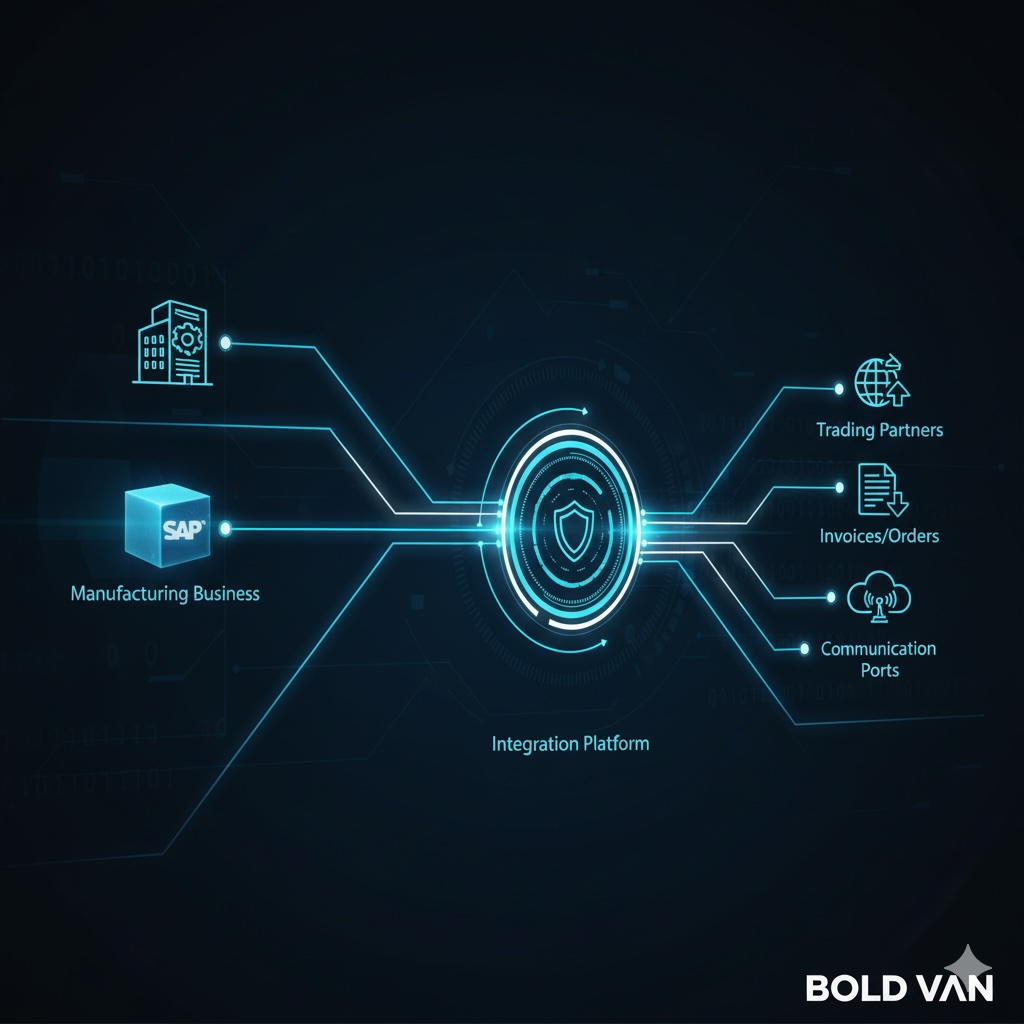
The relevant option is BOLD Integration, which maps EDI into and out of your ERP, WMS or other system. BOLD VAN can also connect to a platform's API when the other side of the workflow does not use EDI. If you already build and maintain your own maps, a connectivity-only service may be a better scope. For this question, however, managed mapping and integration are central to the decision.
What an ERP-integrated EDI platform must actually do
An ERP-integrated EDI platform receives a trading partner's business document, translates its structure into data your system can process and sends your system's output back in the partner's required format. The transport connection, translation map and ERP handoff are distinct jobs. A provider that handles only transport leaves the other jobs with your team.
Consider a common order-to-cash sequence. An X12 850 purchase order arrives, your ERP records the order, an 855 purchase order acknowledgment communicates your response, an 856 advance ship notice describes the shipment and an 810 invoice requests payment. These are standard transaction names, not a universal checklist. Confirm the documents, versions and timing rules in each trading partner's published EDI implementation guide.
BOLD VAN maps data to and from ERP systems including SAP, Oracle ERP and Infor CloudSuite, as well as others. The same integration work can extend to a WMS such as ShipHero, a TMS such as Oracle TMS or an e-commerce platform such as Shopify. Where a platform uses an API, the data can move from EDI to that platform's API or from its API into EDI. Your system's own documentation determines the implementation details.
How mapping works, and where it breaks
Think of a map as a set of translation and business rules, rather than a file converter. An incoming order may identify a customer, destination, item, quantity and requested delivery information. The map must preserve the meaning of that information while arranging it for the ERP. On the way out, it must turn ERP and shipment data into the structure the partner expects. The applicable X12 version, partner guide and ERP configuration determine the exact rules.
The difficult work is often at the boundaries. An item reference meaningful to a buyer may need to be reconciled with your item records. An address can be syntactically valid but route an order to the wrong destination. Shipment data may exist in the WMS while invoice data lives in the ERP. If the source systems disagree, translation alone cannot settle which record is correct.
Check business acceptance separately from EDI syntax. An X12 997 functional acknowledgment tells the sender whether a document passed the receiver's syntax check. It can report acceptance or rejection, but it does not mean the order or its content was accepted. Check the relevant business response and ERP status before treating an order as ready to fulfill.
When a trading partner changes its requirements, we update the map, and minor changes are typically handled at no cost. New maps are typically ready to test in about two days. Testing still matters: an apparently small change can affect downstream order, shipment or invoice handling. Our US-based team can help identify which workflow needs another test.
Compare responsibility before comparing monthly prices
Ask each provider to describe what happens after a partner changes a specification or an invoice fails. The answer exposes the real workload behind a quote. These service models solve different problems:
| Service model | Who handles maps and integration? | Best fit |
|---|---|---|
| BOLD VAN managed integration | The service maps data into your systems and handles trading partner map updates. | You need ERP integration and mapping help with one predictable per-trading-partner price. |
| Connectivity-only EDI | Your team or another integrator maintains translation and the ERP handoff. | You already have mapping expertise and need document transport. |
| Self-managed EDI software | Your team operates maps, testing and integration. | You have dedicated staff and want direct operational control. |
| Web EDI | Users work in a browser rather than an automated ERP flow. | You have a limited manual workflow or a partner that does not use EDI. |
If your staff already maintain maps, BOLD Transmission and Connectivity covers the connection side. For customers or partners that do not use EDI, BOLD Exchange provides web EDI. Neither changes the main recommendation when your goal is to integrate orders and invoices with the ERP while getting mapping help.
For a finance review, list the trading partners you need now and expect to add. Ask who owns map creation, partner testing, specification changes, support and document retrieval. Then compare the monthly scope against the internal work each option leaves behind. A lower connection quote is less useful if your team must build the integration separately.
Test the workflow, then plan the cutover
Start with an inventory of active partners, transaction types, connection methods and systems that create or consume each document. Include seasonal relationships. For every partner, use its published EDI implementation guide and confirm which version applies. That gives your mapping team a defensible starting point instead of relying on an old sample file.
- Trace an inbound order. Confirm the 850 reaches the correct ERP workflow and that someone can resolve unmatched or incomplete data.
- Trace the outbound response. Check that the 855 reflects the business decision, not merely the receipt of a file.
- Reconcile shipment and invoice data. Compare the 856 with actual fulfillment records and the 810 with the ERP invoice. These checks help reduce the risk of chargebacks, an industry problem.
- Practice exception handling. Identify who reviews failed transactions, who corrects source data and who approves a resend.
Every document is tracked in our portal, where customers can search, requeue and report, with notifications when something needs their attention. Use those tools to follow a test document through the handoff rather than assuming transmission equals successful processing. If you are replacing an existing VAN, plan partner validation and production cutover together. VAN migrations typically take about two weeks; new connections are typically live within a business day. Partner testing can affect your schedule.
A managed cloud service also reduces dependence on one employee who knows every map and connection. Before switching, make sure IT and operations agree on ownership of exceptions and a business continuity plan. For a closer look at cutover decisions, read our cloud EDI migration planning guide.
Frequently asked questions
What should an SMB manufacturer prioritize in an EDI platform?
Prioritize integration with your actual ERP workflow, ownership of trading partner maps, a usable way to investigate documents and one predictable per-trading-partner price. Test the order, shipment and invoice flow before deciding.
Can EDI connect an ERP to a platform that uses an API?
Yes. The integration maps business data between EDI documents and the platform's API in either direction. The exact design depends on the platform's documentation, your system configuration and the trading partner's published EDI implementation guide.
Does a 997 acknowledgment mean my purchase order was accepted?
No. A 997 reports whether the receiver's syntax check accepted or rejected a document. It does not confirm that the order or its content was accepted. Check the applicable business response and your ERP status.
How long should I allow to switch EDI VANs?
VAN migrations typically take about two weeks. Build in time to inventory partners, test documents and agree on the production cutover. New connections are typically live within a business day, depending on partner requirements and testing.
Choose the service that owns the handoff
If ERP integration and mapping are your biggest gaps, choose a service that will work through the partner guide, your system's data and the exceptions between them. For manufacturers seeking that managed approach with pay by trading partner, BOLD VAN's BOLD Integration is the place to start. Bring your partner list and a sample of each required workflow to the discussion.